|
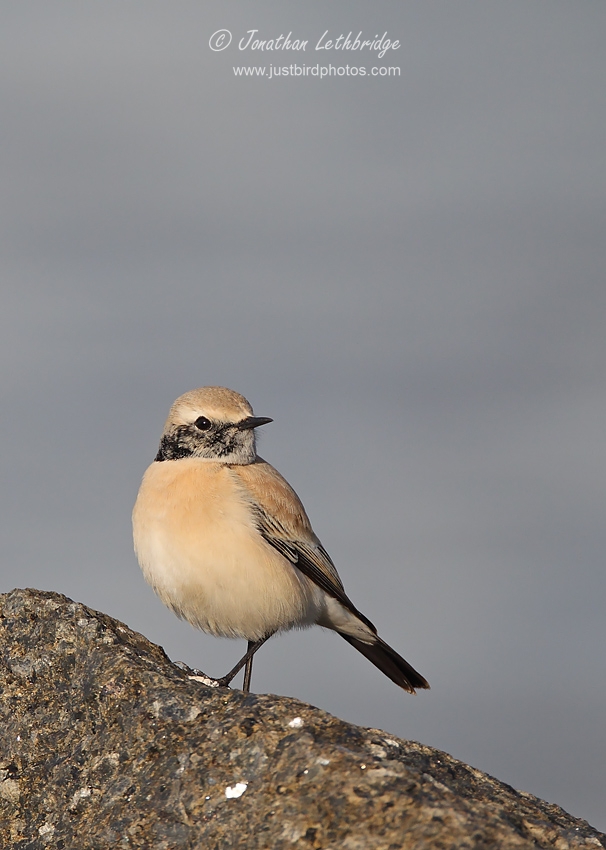
This page will act as a photographic journal. What I'm using, why I like various bits of kit, how I set up certain shots. Stuff that on the whole would act as a massive turn-off for anyone not interested in wildlife photography. Desert Wheatear
November 09, 2014
•
Leave a Comment
I was kicking myself yesterday that I hadn't managed to get over to Kent for what seemed to be a typically confiding Desert Wheatear judging from images on the web. Lucky for me that it stayed, and so my son and I went down there today for mid-morning once news on its continued stay came up. It had already drawn a fair crowd, and so of course there was some nonsense about "you're too close", "don't chase it" from a couple of folk who clearly haven't much experience of this species as a vagrant. Nonetheless to avoid criticism, unjust or otherwise, I waited to properly close in until the bird carried on its circuit and the old boy way up front got bored, before nipping in and waiting close to the favourite rocks by the shore. Didn't take too long before it was back and parading around right in front of me, and so sure enough I was joined by quite a few other camera-jockeys. Did the bird mind? Of course it didn't - and so we all enjoyed a superb experience. The light was dreadful in the morning, but I came back for seconds an hour or so later when it had improved and got some much nicer images, and I've thrown out most of the ones taken in the morning. Kit used was the 800mm (perfect for the twitches where perception of distance is likely to be an issue) and so I was able to initially hang back, and then once the sun came out, popped on the converter for some frame-fillers at 1120mm. This combination never ceases to amaze me, and though I don't in truth use this lens very much, whenever I do I realise why I continue to hang onto it. For support I used my monopod, it's great to be able to change height very quickly and thus sort out backgrounds depending on where the bird lands, and it can be done three time quicker than a tripod!
Wheatear
October 28, 2014
•
Leave a Comment
My regular reader will know that Wheatears are by far my favourite subject. I make trips to photograph single species, and ultimately plan to try and photograph them all - ideally without travelling to some of the scarier parts of the world. This latest image is only of a Northern Wheatear, but was possibly the most pleasing from the whole of last weekend. I spotted a bird on a small mound, and we maneuvered the car close by. As we were doing so, the bird flew in even closer, almost as if it were checking us out. "Kill the engine! Kill the engine!", and as the car shuddered to a stop I fired off half a dozen frames - as luck would have it my manual exposure from a few minutes before was still appropriate, 1/800s at f5.6. Handheld resting on the car door frame, a real grab shot, no planning at all. Love it!
American Golden Plover
October 27, 2014
•
1 Comment
Here are a few images of the extremely photographic American Golden Plover at Davidstow Airport in Cornwall. I happened to be in the South-west anyway..... Tactic was to roll up to the bird in the car, and then take photos out of the window. This proved unsatisfactory, so I stealthily snuck out of the car on the opposite side to the bird, and edged my way around the front on my stomach whilst resting the lens on my coat. Not a bad tactic as it turns out, but my desire for ground-level shots is really starting to hurt my neck. I really need an angle finder, or I need to use my Wimberley on the frisbee thing. Trouble is I can never be bothered with that, and so yesterday I actually gave myself a headache taking these photos. Idiot. Anyway, that's all behind me now, and so here are a few of the results. All taken with the Canon 1D Mk IV, coupled with the 500mm f4 and 1.4xx converter. 1/800 at f5.6, ISO 800 and neck ache.
Jays
October 19, 2014
•
Leave a Comment
It is Jay season! Most of the year you cannot get a look in, however around now the birds start to collect and store food for the coming winter, and this urge for the most part overcomes their natural shy tendencies. I can only manage a few snippets of time here and there, but went up to a place where I've been seeing quite a lot of activity. The Jays were there, as predicted, and numbered up to four birds. It's also a place which sees a lot of human activity, and this works both for and against a photographer. The birds are more used to people, but people are bloody senseless sometimes - including this morning a guy walking between me and the birds. They all flew away, I thanked him very much indeed, and he told me to F*** Off. This is what you have to put up with in London unfortunately, getting a decent shot has to be a lot harder than in some other places. Unsurprisingly this is roughly when my photography session ended, but by then I had a few keepers. Many were taken in deep shade, but if you hold the dropper tool on an element of white at the point of RAW conversion, this sets your white balance to a far more natural looking tonality, rather than the gloomy purples you tend to get. So here are a few from this morning - all with the 500mm, both with and without the converter. Because of the gloom I used my monopod - although there were brief patches of sunshine, most often my shutter speed was sitting at around 1/200s. I think that next time I might actually take a tripod, and possibly the longer lens for more opportunities.
Lapland Bunting
October 19, 2014
•
Leave a Comment
A Lapland Bunting recently graced Wanstead Flats, a pretty rare bird for London. I managed to get it on the first evening, and the bird was just so confiding. But having come straight from work I had no camera, and so returned the next day when I was lucky enough to have a bit of early morning sunshine. It didn't seem quite as approachable this time around, and it mostly just crept around the tussocks, but with a little patience I was able to position myself in locations where a clear shot was just about possible. I say just about, as the vertical crop below actually had a few stems of grass through the bird - some detailed work with the clone stamp tool sorted that out though - the trick is to zoom right in and work on one feather at a time. Details are 700mm (500mm + 1.4x), 1/1000s at f5.6 - handheld, as I tend to do ever more frequently.
|