|
This page will act as a photographic journal. What I'm using, why I like various bits of kit, how I set up certain shots. Stuff that on the whole would act as a massive turn-off for anyone not interested in wildlife photography. Whinchats
August 29, 2012
•
Leave a Comment
There were quite a few Whinchats on Wanstead Flats this morning, perhaps up to six individuals. They were not easy to approach - birds in groups are usually far more easily spooked than lone birds. It took some chasing around, but eventually one of them did allow me to get close enough that I could get at least something with the 800mm and 1.4x converter. It was pretty breezy, so both the stem the bird was on and the monopod the lens was on were moving about like anything. In situations like this I just shoot as many frames as I can and cross my fingers. All in all I was pretty pleased given the incredible focal length involved, but I can't help thinking that to get that killer shot I just have to be a lot lot closer, and that's the hardest part of all!
Common Sandpiper
August 21, 2012
•
1 Comment
A fantastically behaved Common Sandpiper has now been on one of my local ponds for about a week. I finally managed some quality time with it at lunchtime today. A bit rushed, but nonetheless I'm quite pleased. Background was challenging to say the least, but I think I managed to avoid all the litter. Monopod used as normal, makes things ever so much quicker - I must do a post on monopods at some point, they are vastly underrated in my opinion.
Return to Oare
August 12, 2012
•
Leave a Comment
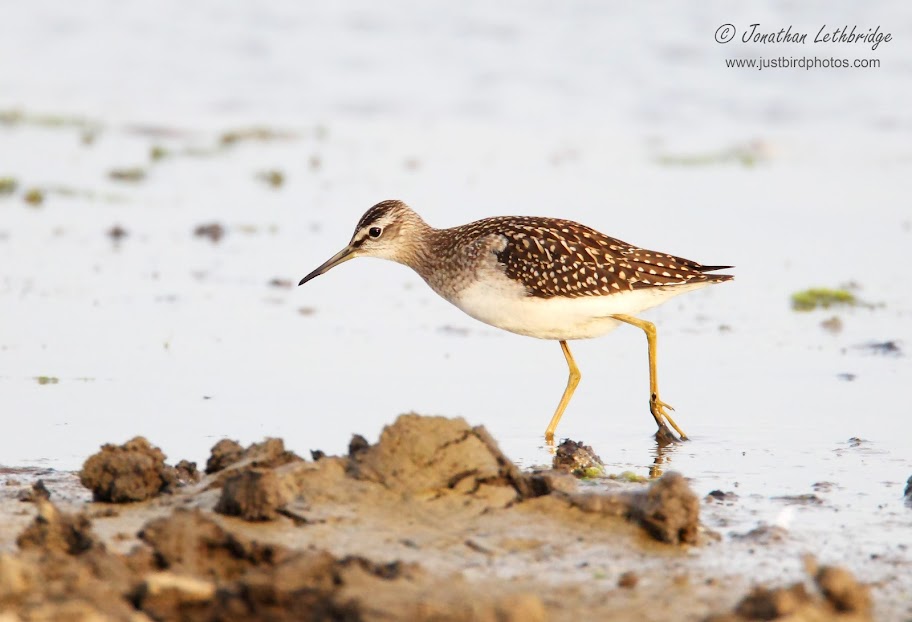
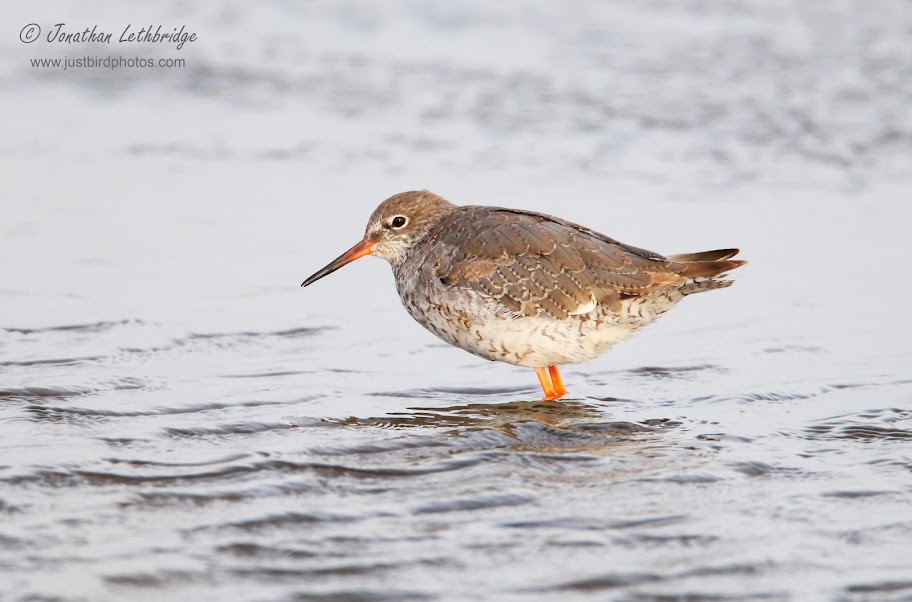
Went to Oare Marshes on Saturday evening hoping for some more waders. Once again stymied by the distance, and also by a strong breeze. It's a great reserve, and I suppose that the fence down the side means that the waders do stay on view rather than get flushed, but I just wish I could crawl out a bit! I also forgot to bring a lens for flight photography, something I must remember to do next time - the birds that are mostly too far out to get on the water are constantly flying overhead and out to the Swale. Flight Photography is my nemesis; I'm no good at it so I don't do it. Because I don't do it, I don't get any better. An afternoon at Oare would surely help! Anyhow, for the birds on the scrapes, only a few are close enough to try and photograph, which means they're close into the bank. In order to counter this and see over the top, I had to have the tripod at max, which with the wind and with nearly 1500mm of focal length (800mm + 1.4x) I was really struggling to control the wobbles. In these situations it's a case of fire and forget - some shots, despite the wind and distance, will probably come out OK, and so it proved. None of them are top notch, critical sharpness is obviously lacking, but they're still the best photos of Wood Sandpiper I've ever taken, and so for now that's fine. The height of the tripod also precludes getting a decent angle on the birds, as you can see below it's very obvious, unfortunately, that I'm some way above the bird - unlike those Sanderling from a couple of weeks ago.
One of the things I have on my to-do list is to make up a list of target birds I want decent photos of, and then work out locations and timings of how I'm going to get them. For instance, I've never taken a satisfactory photo of a Wren, - crazy isn't it? Common bird, onmipresent, and yet no decent images, in fact hardly any rubbish ones either - I have almost completely overlooked the species. When I've made this list, I might put it up here and hopefully if I have any readers they might suggest good locations to me!
Eye-level waders
July 31, 2012
•
Leave a Comment
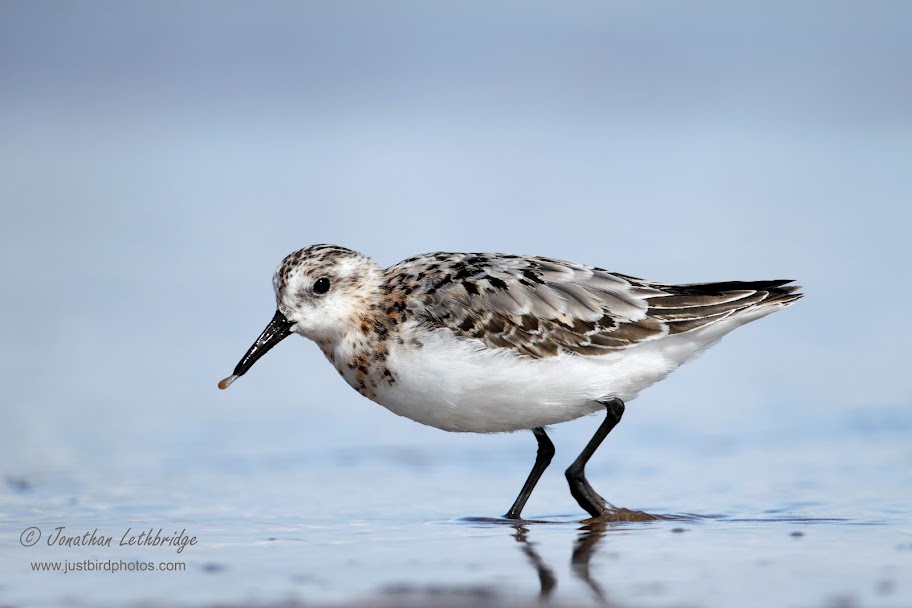
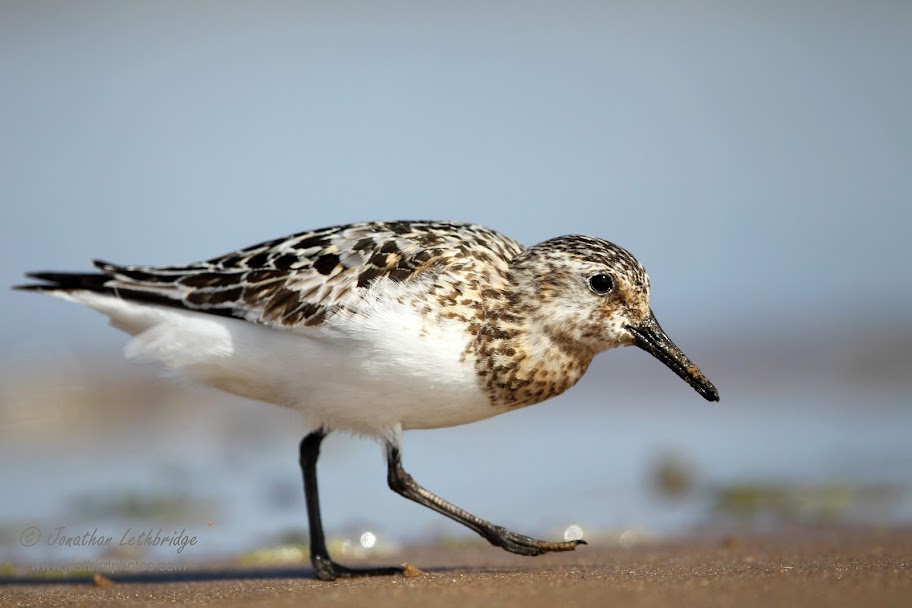
I just love getting down in the sand to photograph waders. Less so mud, but I'll do it if pressed. Getting low for ground-based subjects makes images much stronger - the flipside is that you pay for it by getting mucky. I went up to the beach at Titchwell at the weekend as the tides looked just right to push summer-plumaged waders up to my waiting lens in the early morning light. It didn't quite pan out as expected, as all waders other than Sanderling buggered off long before the water pushed them anywhere near me, but you make do with what you can get. And anyway, I like Sanderling, and even though I've got some decent shots of them before, I felt I could probably do better. Here are a few - the light was really good for the most part - a little bright perhaps, but still eminently workable. Although the long lens does have the perspective to allow you to shoot whilst crouched and still have somewhat of an eye-level view, I chose to go the whole hog. Tripod legs completely splayed (luckily I don't have a centre-column), with the ballhead and Wimberley Sidekick holding the lens perhaps 20-25cm above the sand.
No other waders came close, but I'm pleased with what I came home with. I ended up taking exactly 1500 shots during the day, and my first edit reduced this to 220 or so. This is a good rate - around 15%. My final cut ended up with 20 making it to this website. There's nothing wrong, per se, with the other 200, but you have to be ruthless in this game. As usual I took far too much kit with me. A scope for birding didn't get used much, and the macro lens, wide-angle, spare body and 70-200 (in case the waders came really really close) didn't get used at all. I ached a great deal the next day, which compounded with four horsefly bites that swelled up like you would not believe had me wondering whether it was all worthwhile. Of course it was! Time with my camera is me time. I love it!
Teleconverter Thoughts
July 15, 2012
•
Leave a Comment
I've not been out much in the last two weeks. I've been very busy at work, and the weather and family committments have mostly put-paid to any time in the field, with a camera or otherwise. I managed to sneak about an hour and a half this morning, and decided that I'd try out my 2x teleconverter. My 1.4x converter is almost permanently bolted to my 500mm lens - I work at 700mm f5.6 more often than not - just a quick browse through the images in the gallery is proof. But I rarely, if ever, use the 2x converter. I carry it round with me each time I go out, heck, the thing even cost me nearly £400, yet it hardly ever gets a look in. Why? Well I've never really been happy with the resulting quality. Plenty of people are though, and can get results that I would put into the "fantastic" bucket. I am sure that, as always, the limiting factor is me and not the equipment, so off I went for another attempt. The weather wasn't wonderful - bright sunshine, plenty of haze, and a stiff breeze which played havoc with the monopod. A tripod would have been sensible, but on the patch, the monopod is the way I shoot. If the 2x can't fit in with my plans, then it isn't coming out and that's that. I was determined to give it a go, even with subjects where I could easily have taken it off and work with the native 500mm, which I know is simply superb. So 1000mm at f8, and to compensate for f8 and the slow shutter speeds I would likely get, ISO 800 - my normal working is ISO is 400. First up, a Pigeon. Only the centre point is active at f8 - another thing to learn to work around. In vertical composition I would normally select a point about 2 up - this wasn't available. Here's the result, at 1/1600s. I think it's just about OK.
Granted Pigeons aren't the most exciting of birds, but as a photographer I don't care, I'll take photos of anything. I couldn't find any Skylarks or Meadow Pipits that would cooperate, they were all miles out into the grassland. A shame, as part of the reason I wanted to try out 1000mm was to see if it could be reliable on small birds where you're always starved of focal length. OK so I could have got more on them than with 700mm, but beyond a certain range there is just no point. Perhaps this is why I've never been happy with the 2x before now, I've always been trying to get something far too distant that bit closer, and it's still just messy pixels no matter how much length you have. There is no substitute for being as close as you can. So next stop Alexandra Lake, which was very nearly devoid of life! A few Coots, a Moorhen, and some scruffy Mallards. Nevermind, we'll work with what we've got!
Don't you just love Coots?! This one was at 1/1000s at f8, and is sharp enough, but then again I was very close. Clearly the 2x is no slouch optically, you just need to limit when you use it.
Similarly, this Mallard has acceptable sharpness - ignore the massive white blob in the background, I think it's part of a Mute Swan. In previous experiences with the 2x, it's been the sharpness which has been a massive let down - those that know me are probably bored witless by my talk of sharpness, but it's got to be the most important factor. Forget composition, colour, and the rest of it. If the photo isn't sharp, it's trash from the word go. Of 150 photos taken, I kept only 12. That's low, but the rest of them just weren't there. I had shutter speeds that theoretically were fast enough, but they were either a little soft, or unacceptably so. This is most likely poor long lens technique, combined with a monopod on a windy day, but I've never been one for shooting test charts with everything locked down, as that's not what I'm going to encounter out birding. As well as low sharpness, I also found that the images just didn't pop as much, even with my usual post-processing. The extra glass of the converter appears to cut out depth of colour as well, or at least that's my perception. I still think it's a useful tool, but unless I get a lot better, then I doubt any of my photos at 1000mm are going to find their way into the galleries. I know I can do a good job with 500mm and even with 700mm, but 1000mm is - for now - a step too far.
|