|
This page will act as a photographic journal. What I'm using, why I like various bits of kit, how I set up certain shots. Stuff that on the whole would act as a massive turn-off for anyone not interested in wildlife photography. Isabelline Wheatear
October 07, 2013
•
1 Comment
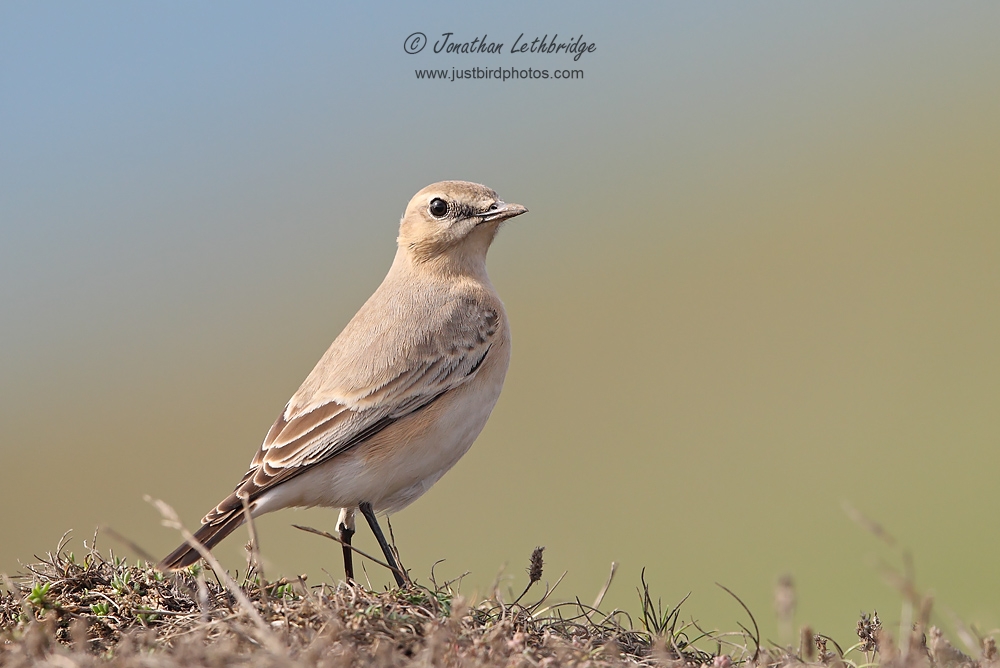
As you may know, Wheatears are my favourite species. Wheatears of any description - one of these days I'd love to illustrate a book solely on Wheatears in fact, but that is for another day - for a start I haven't seen them all! I digress - when I find one that is photographable, by which I mean I can get close to it without it being bothered, then I'm at my happiest. Saturday was one of those days where it all came together. In addition to being a UK lifer, I'd also seen some photographs on the net that indicated to me that the bird was probably a good 'un - although they weren't the greatest photos ever, they showed distinct promise! Predictably it was miles away, and I mean properly miles, about 600 round trip, but I had more or less made up my mind. I had the time, I had the car, and I had the desire! I waited on news Saturday morning, and when it came through at around 9am, it was game on. A mind-numbing 5 hours later and Nick and I arrived at the one of the very western tip of Wales. Trudging up the short slope, legs numb from the journey, we followed a path through bracken to the cliff edge, and there found the bird almost immediately - extremely pale and stood out like a sore thumb. There were only about four others there for the bird, and they suggested that the bird liked to come back to the same area of grass where somebody had placed mealworms earlier on. None were left, but nonetheless the thought of finding a hidden crumb kept the bird returning, and it was simply a matter of waiting. With lovely light, there were some choice backgrounds on offer - pure green, pure blue, or a mixture of both. And as usual, down to bird eye level! Monopod dispensed with, I flat on my stomach (still just about possible!) and supported the lens with both my elbows, left one in front, right one tucked in a bit, and waited for the bird to return. This it did every now and again, flying in with some Northern Wheatears, and then running in a little bit closer. It was then simply a matter of tracking it around the place and waiting for a nice combination of pose and background, altering my height as appropriate in order to get a particular background, though obviously if the bird was super-close I didn't move. Although I was lying a little ways in front and to the side of some of the other people, the bird probably approached me to within ten feet on multiple occasions. Why the others decided to stay further away, and with lenses of top of tripods pointing down at the bird I will never know, but I see it all the time. I know which images I'd rather have! All the below were using the 1D Mark IV, my body of choice, and the 500mm f4 Mark II lens, with the 1.4x converter attached - despite the bird's proximity at times, I wanted as much on it as I could, and the converter seems to lose me nothing on the quality front. All images manually set at 1/1600s or 1/2000s, and at f7.1 or f8, as with the bird close I needed to stop down to ensure as much of it was in focus as possible - had I used f5.6 I might have been caught short, but at the same time I needed a fast shutter speed as I was hand-holding - the settings mentioned seemed to be the best compromise. ISO 800 was therefore also a compromise, but with noise reduction in even the venerable CS2, they look fine to me. So, that's the technical stuff out of the way - I hope you enjoy viewing them as much as I enjoyed taking them!
All the gear, some idea
September 25, 2013
•
1 Comment
I had a comment recently over on my other blog. It was a comment that was very complimentary about some photos I had taken, and it annoyed me a great deal. Here's why. Following on from the high praise was this - you must have a very expensive prime lens. Ah, you see, that's not the right thing to say, at least not to me. They went on to say that their attempts with a different, less-expensive but still pro lens, hadn't delivered results that were as good. I went and checked, and they were spot on. So what is being said here exactly? That the reason my photos are sometimes good is because I have an expensive lens? That therefore if all people had expensive lenses that their photos would all be good? What a load of rubbish! I see heaps of people in the field with large expensive lenses, all the gear. When I get home I sometimes look some of them up. By far the majority, and this is no exaggeration, have with all that gear taken a pile of complete garbage fit only for the trash. It ain't the lens, and it ain't the camera. Dear commenter, do you know what it is? Don't get me wrong, the lens helps, a camera with a great autofocus system helps, using support helps, but without a competent photographer at the other end of it who knows how to use it, none of it is worth a thing. And that is what people sometimes fail to grasp, and that without fail annoys me. Would you compliment a chef on a lovely tasty meal, and then tell him he must have a great cooker? No. Would you remark that an artist must have wonderful brushes? No. I'm not claiming to be a top-notch bird photographer, but I am claiming that I'm competent. And that's the important part. I'd be willing to bet money that if I swapped gear with any person who said the reason I got better results was because I had a better lens than they did, that with very few exceptions, perhaps none, I'd still take the better photo. That's because I have practised for hours, I have abused shutters like you would not believe. I understand exposure theory, I know what a histogram is, and I know my camera like the back of my hand. My camera has 45 focus points, I use one. It has several exposure modes. I use none. I know what angles can deliver the most pleasing images, I get low, I use a monopod for support with speed and flexibility, I spend hours with a single subject. I get wet, I get cold, I get uncomfortable and I walk miles. And sometimes I come home with NOTHING. If I do get something worth keeping, I work on it on the computer for ages. Hours in Breezebrowser, hours in Photoshop. Tweaking, cropping, cloning, learning. Learning all the time. These are the reasons why the images look good, not because I also happen to flog my guts out in the City and can therefore afford top quality kit. So to anyone that thinks the reason their images don't stack up is because they don't have the gear, whatever you do don't go out and buy it all, as that's not the problem. Rant over.
Arctic Skua
September 24, 2013
•
Leave a Comment
Whilst twitching the Lesser Grey Shrike in Suffolk at the weekend, team East London was made aware of a nice and showy Arctic Skua on the beach at nearby Sizewell. With the Shrike not giving itself up for any type of meaningful photo, I was pleased to at least have something else to point the camera at. The bird, unfortunately, was not well. Some clear oiling to the plumage, especially on the left wing. Nothing too serious, and it was flying around pretty nippily doing all the usual Skua stuff, but it was clearly not comfortable, spending a lot of time preeing and bathing, and this no doubt explains why it has spent a whole week on the beach. I've never photographed this species before, and assumed it was silly tame - more fool me. It was anything but tame, extremely wary indeed of advancing humans, and a very careful and low approach was needed if you wanted to get really close. The bird was fine to about 20 metres, but I wanted a lot closer than that, and eventually closed to perhaps six or seven. It watched me the whole way in, and the eventual successful tactic was to shuffle in a bit more every time it returned to preening. Ideally I would not have had the bird against either the featureless sky or north sea, but it seemed to like perching on a shingle ridge which made anything else virtually impossible given the low approach and the need/desire to be at the same level as the bird. Had I approached from the seaward side, which was also into the light, I could have had a shingle background whilst standing up - I opted for the white/grey-out instead! All photos taken with the 800mm, either handheld or on a monopod at its shortest setting. For a few of the images I created a little shingle mound on which to balance the camera, so this may have helped get that bit sharper. Dull light unfortunately, but I was still pleased to be so close to this species. I wasn't able to read the ring, but hope it recovers and gets to wherever it is going.
Whinchats
September 01, 2013
•
1 Comment
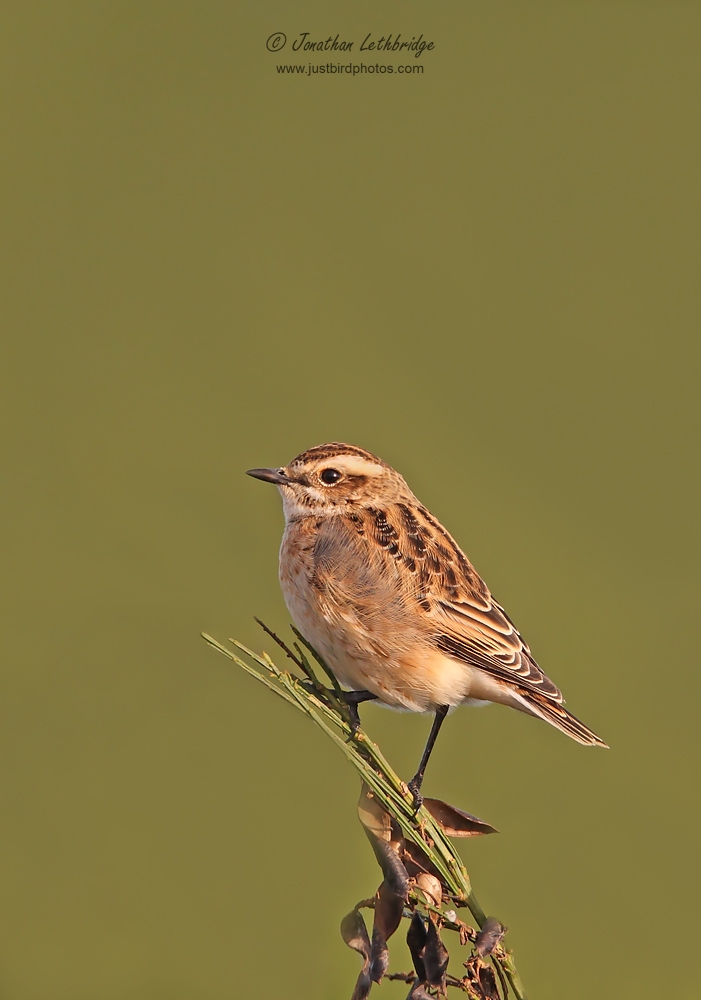
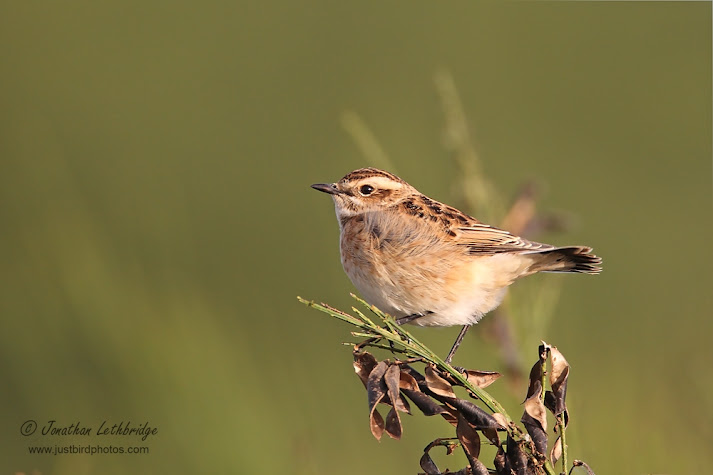
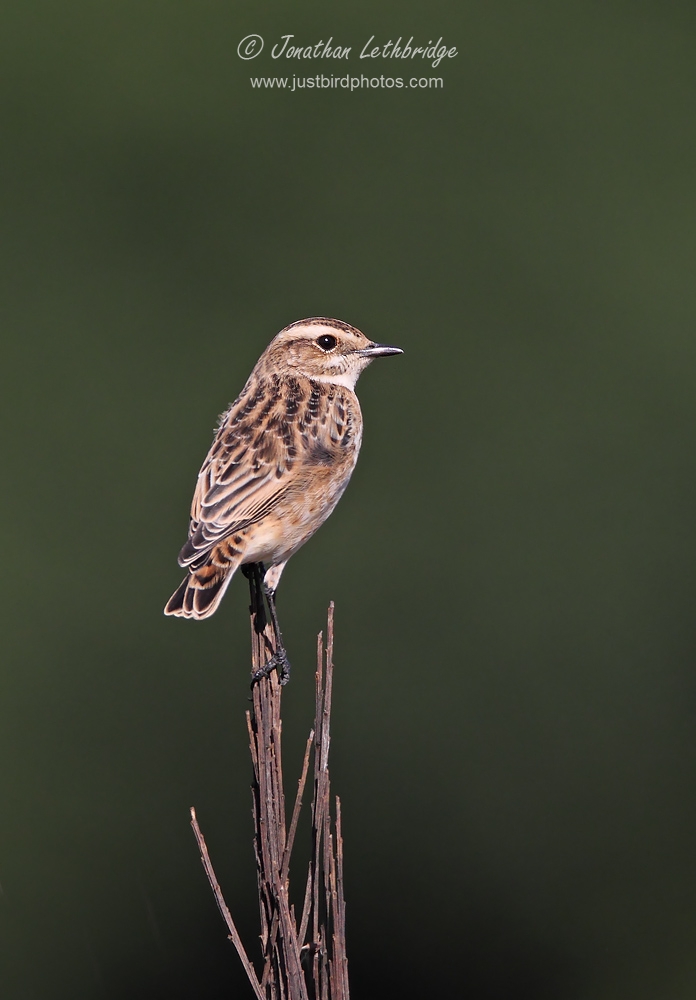
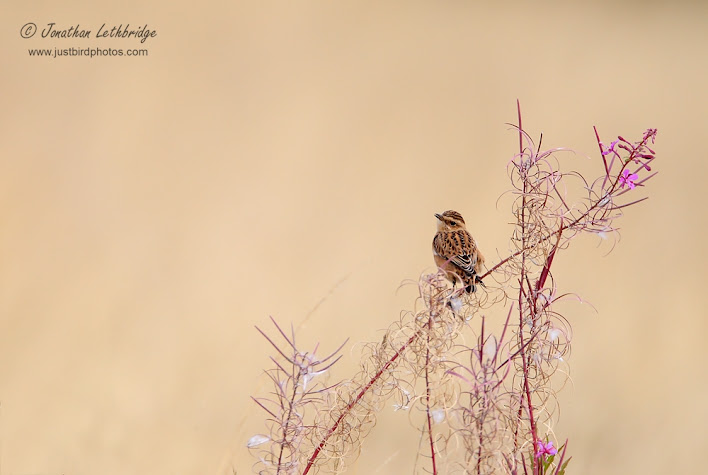
Yet another post extolling the virtues of Canon's stellar 800mm prime I'm afraid. For the past week or so there have been several Whinchats hanging around the patch. For many years I had no images of these smart little birds, but last year I managed a few whilst maxed out with the 800mm and the 1.4x converter. With a 1D body you retain AF, albeit it with the central point only, however the real challenge is simply dealing with the enormous focal length of 1456mm, and somehow keeping your image sharp enough to publish. The rule of keeping a shutter speed equivalent to your focal length is almost irrelevant here, the biggest challenge seems to be the air itself, and once a little heat appears photography with this combo is at an end. Yesterday I hit the patch with this lens, and with the 1.4x converter already in place - I knew I would need it, Whinchats are not renowned for being approachable. If anything the birds were even more flighty than I expected. In over two hours of lugging the gear around - weighing in at something like 7.5kg all told - I managed about thirty seconds of photography. Such is life, but here are some of the results. In the first image I have tidied up the excess foliage, however for rest of them I couldn't be bothered. I love a nice clean image, but most of the time it simply isn't possible, and I do sometimes need to resort to a bit of cloning. As I develop as a digital photographer, I'm beginning to have half a mind on Adobe Photoshop even as I press the shutter, it's just the way you start to think. When you know you can't get the 100% clean image you have in your mind, you know that even if you alter your position slightly, you have an image that you know you can deal with in post-processing. What would the Velvia shooters have thought of these new ways? Annoyed that they were not part of this generation I expect! Digital photography makes things so so easy. Not completely facile, just look at the proliferation of utter dross all over the net, but easy enough that if you spend a little time, take a little care, and are cogniscent of the possibilities before you even press the trigger, then decent images are the norm rather than the occasional. So, any photo of a Whinchat, for me at least, is a complete bonus, but if a little work in Photoshop is needed to make the image shine, why not. The first image in the sequence has undergone cloning only. That is to say that where there was stuff in the background, in this instance out-of-focus foliage on a different plane, I've used parts of the clean background to cover that up and get the uniform look I wanted in the first place. After over an hour of chasing Whinchats around I wasn't about to hold off simply because a bit of Broom was in the wrong place! I'll say it again, I am astonished by the quality possible with the 800mm + 1.4x converter (Mk III), and with only a monopod for support. Heavy, and I much prefer using a shorter lens, but there are times when you need all you can get, and nothing else comes close. 700mm, i.e. the 500mm with the 1.4x converter, and I would have been nowhere. Tripod would have been ideal, but I suspect that in the time it would have taken me to extend the legs and so on that the birds would have moved on. The flexibility and mobility of the monopod is worth the sacrifice in stability. No such thing as a free lunch anywhere in photography, nonetheless I'm pleased by what I managed to achieve in the circumstances.
|